
Stress Testing the Engine: TMT
A Scientific Guide to the “Stress Test”
Resting ECGs are like taking a picture of a car parked in a garage. It might look perfect, but you won’t know if the engine overheats until you drive it up a steep hill. This is the exact physiological principle behind the Treadmill Test (TMT), also known as the Exercise Stress Test.
This article details the technical procedure, the “Duke Score” prognosis, and what exactly happens to your heart when we force it to work harder.
1. The Physiological Concept: Supply vs. Demand
Your heart muscle (myocardium) has a variable demand for oxygen.
- At Rest: The heart pumps ~5 liters of blood per minute. The coronary arteries easily supply enough oxygen even if they are 50-70% blocked by plaque.
- At Peak Exercise: The heart may pump 20+ liters per minute. Oxygen demand triples.
- The Mismatch: If a coronary artery is narrowed (stenosis), it cannot dilate to increase flow. The heart muscle downstream runs out of oxygen (ischemia). This electrical “cry for help” appears on the monitor long before permanent damage occurs.
2. The Procedure: The “Bruce Protocol”
The test is standardized globally using the Bruce Protocol, which increases difficulty in 3-minute stages.1
A. Preparation (The Setup)
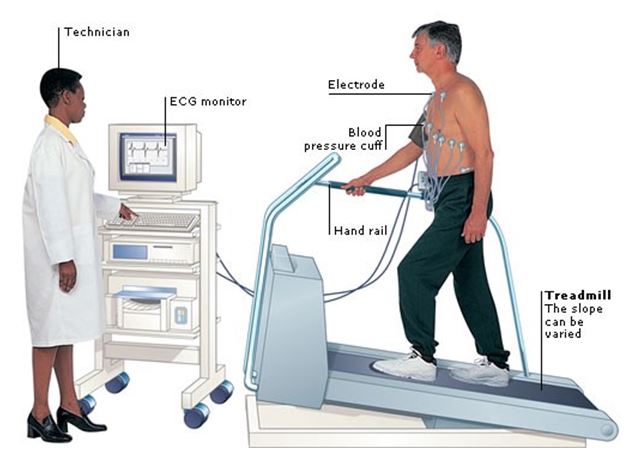
- Mason-Likar Lead Placement: Unlike a standard ECG where stickers go on your ankles and wrists, the limb leads are moved to your torso (shoulders and belly).2 This reduces “motion artifact” (interference caused by moving limbs).3
- Baselines: Your resting Heart Rate (HR) and Blood Pressure (BP) are recorded.4
B. The Run (7 Stages)
The treadmill starts slowly but gets faster and steeper every 3 minutes.5
| Stage | Time | Speed | Incline (Grade) | Intensity (METs) |
| 1 | 0-3 mins | 1.7 mph (Slow walk) | 10% (Steep hill) | ~4.6 METs |
| 2 | 3-6 mins | 2.5 mph (Brisk walk) | 12% | ~7.0 METs |
| 3 | 6-9 mins | 3.4 mph (Jog/Run) | 14% | ~10.0 METs |
| 4 | 9-12 mins | 4.2 mph (Run) | 16% | ~13.0 METs |
| Target | Most diagnostic data is found here. |
What is a MET? MET stands for Metabolic Equivalent.6 1 MET is the oxygen your body consumes at rest (3.5 mL O2/kg/min).7 Stage 3 (10 METs) means your heart is working 10 times harder than when you are sitting on the couch.
C. The Recovery
The most critical part is often after the treadmill stops. You will sit or lie down immediately. In rare cases, abnormalities only appear during this “cool down” phase as the heart recovers.
3. Interpreting the Data: What Doctors See
The cardiologist is looking for three specific things on the monitor:
- ST-Segment Depression: This is the electrical signature of ischemia.8 On the ECG line, if the segment after the heartbeat “sags” downwards (>1mm), it indicates the inner layer of the heart muscle is starving of oxygen.
- Chronotropic Competence: Does your heart rate rise adequately?
- Target Heart Rate = 9$(220 – \text{Age}) \times 0.85$.10
- If you are 50 years old, your target is $170 \times 0.85 = 144$ bpm. Failure to reach this makes the test “Inconclusive.”
- Symptoms: Angina (chest pain) or Dyspnea (severe breathlessness) that reproduces your daily symptoms.11
The “Duke Treadmill Score” (DTS)
This is a calculated score that gives a scientific prognosis (5-year survival rate).
$$DTS = \text{Exercise Minutes} – (5 \times \text{ST Depression}) – (4 \times \text{Angina Index})$$
- High Risk (Score < -11): High probability of severe blocked arteries. Angiogram needed.
- Low Risk (Score > +5): Very low risk of heart attack in the next few years.
4. Risks and Contraindications
Who should NOT do this test?
- Absolute Contraindications: Acute Heart Attack (within 2 days), Unstable Angina (chest pain at rest), uncontrolled arrhythmia, or severe Aortic Stenosis.12
- Limitations: Patients with arthritis or knee problems who cannot walk fast enough to stress the heart will get an “inconclusive” result.13 They require a Dobutamine Stress Echo (chemical stress test) instead.
Risks:
The risk is very low (1 in 10,000).14
- Hypotension (drop in BP).15
- Arrhythmia (irregular heartbeat during peak stress).16
- Myocardial Infarction (rarely, the stress itself can trigger a heart attack, which is why it is done in a hospital setting).17
Summary Checklist
- Wear running shoes: You will be exercising vigorously.
- Stop Beta-Blockers? Ask your doctor. These drugs prevent heart rate rise and can mask the test results.
- Don’t eat heavy: Avoid large meals 2 hours prior to avoid nausea.18